17 Photons and Electrons
Suggestions of all kinds for this book draft are welcome — whether it’s fixing small errors, raising bigger questions, or offering new perspectives. Please share comments through GitHub Issues. To make feedback easier to address, please point to the section you have in mind — by section number or a short snippet of text.
17.1 Photons and Electrons overview
The transition from film to digital imaging began when Willard Boyle and George Smith showed that light could be captured electronically within semiconductor silicon (Boyle and Smith (1970); see Preface). Digital image sensors use arrays of tiny, light-sensitive semiconductor elements called photodiodes to convert incoming light into electrical charge.
Whether an image sensor is an early charge-coupled device (CCD) or a modern complementary metal-oxide-semiconductor (CMOS) sensor, the fundamental physics of detection is the same: photons absorbed in silicon liberate mobile electrons.
In this chapter, we explore this physical conversion: how the photoelectric effect generates charge carriers in silicon, how efficiently photons are converted to electrons (quantum efficiency), and why the quantum nature of light introduces unavoidable statistical fluctuations (shot noise). In the next chapter (Chapter 18), we examine the engineering architectures used to store, transfer, and measure these electrons.
17.2 Photoelectric effect
The physical principle underlying photodiode operation—converting light into electrons—is called the photoelectric effect. Understanding how materials convert light into electrical signals is a foundational chapter in physics and engineering, shaped by experiments and theories that changed how we think about light and matter. In metals and vacuum tubes, the effect refers to electrons being emitted from a surface into vacuum. In semiconductors (as in photodiodes), absorbed photons create mobile charge carriers (electron–hole pairs) that are collected by circuitry.
Heinrich Hertz was the first to report an unexpected phenomenon related to electromagnetic waves that would later be recognized as the photoelectric effect (Hertz 1887a, b). His primary goal was to measure the electromagnetic waves predicted by Maxwell’s theory. For this, he used a two-part apparatus:
The Transmitter: This consisted of a large induction coil connected to a spark gap (often with attached metal plates acting as a dipole antenna). The induction coil produced high-voltage pulses, causing powerful, oscillating sparks to jump across this gap. These sparks were the source of the electromagnetic radiation (radio waves) that Hertz aimed to study.
The Receiver: This was a separate, much smaller loop of wire, also containing a small spark gap. The receiver was placed at a distance from the transmitter. When the electromagnetic waves from the transmitter propagated to the receiver, they induced an oscillating current in the receiver loop. If the induced current was strong enough, a tiny spark would jump across the receiver’s gap, signaling the detection of the electromagnetic waves.
During these experiments Hertz made a crucial incidental observation: a spark in the receiver gap was significantly enhanced—jumping a longer distance—when the gap was illuminated by ultraviolet (UV) light from the transmitter’s spark. Placing a glass plate (which blocks UV) between the transmitter and receiver diminished the receiver spark; a quartz plate (which transmits UV) did not. Hertz concluded that UV light was facilitating the spark in the receiver gap. This was the first report of what we now call the photoelectric effect: light causing emission of charged particles (later identified as electrons) from a material surface, thereby influencing electrical signals.
Hertz correctly concluded that UV light was somehow facilitating the spark in the receiver gap. This observation was the first report of the photoelectric effect – the phenomenon where electromagnetic radiation, specifically UV light in this case, causes the emission of charged particles (later identified as electrons) from a material surface, thereby influencing electrical signals. The central challenge of the photoelectric effect is to model how electromagnetic radiation—light—interacts with a material to generate an electrical signal.
17.3 Discovery of the photon
In 1897, J. J. Thomson conclusively demonstrated that cathode rays are streams of negatively charged particles—electrons—with a specific mass and charge, much smaller than an atom.
In 1902, armed with knowledge of electrons, Philipp Lenard carried out a series of important experiments. He observed that increasing the intensity of the incident light increased the number of emitted electrons but did not increase their kinetic energy. Instead, the energy of the emitted electrons depended on the wavelength of the light: shorter wavelengths (higher frequencies) produced more energetic electrons. Lenard also identified a threshold wavelength—if the light’s wavelength was too long (i.e., its frequency too low), no electrons were emitted, regardless of how intense the light was. These results posed a serious challenge to classical wave theory, which predicted that energy should increase smoothly with intensity, not depend on frequency.
The Experimental Setup
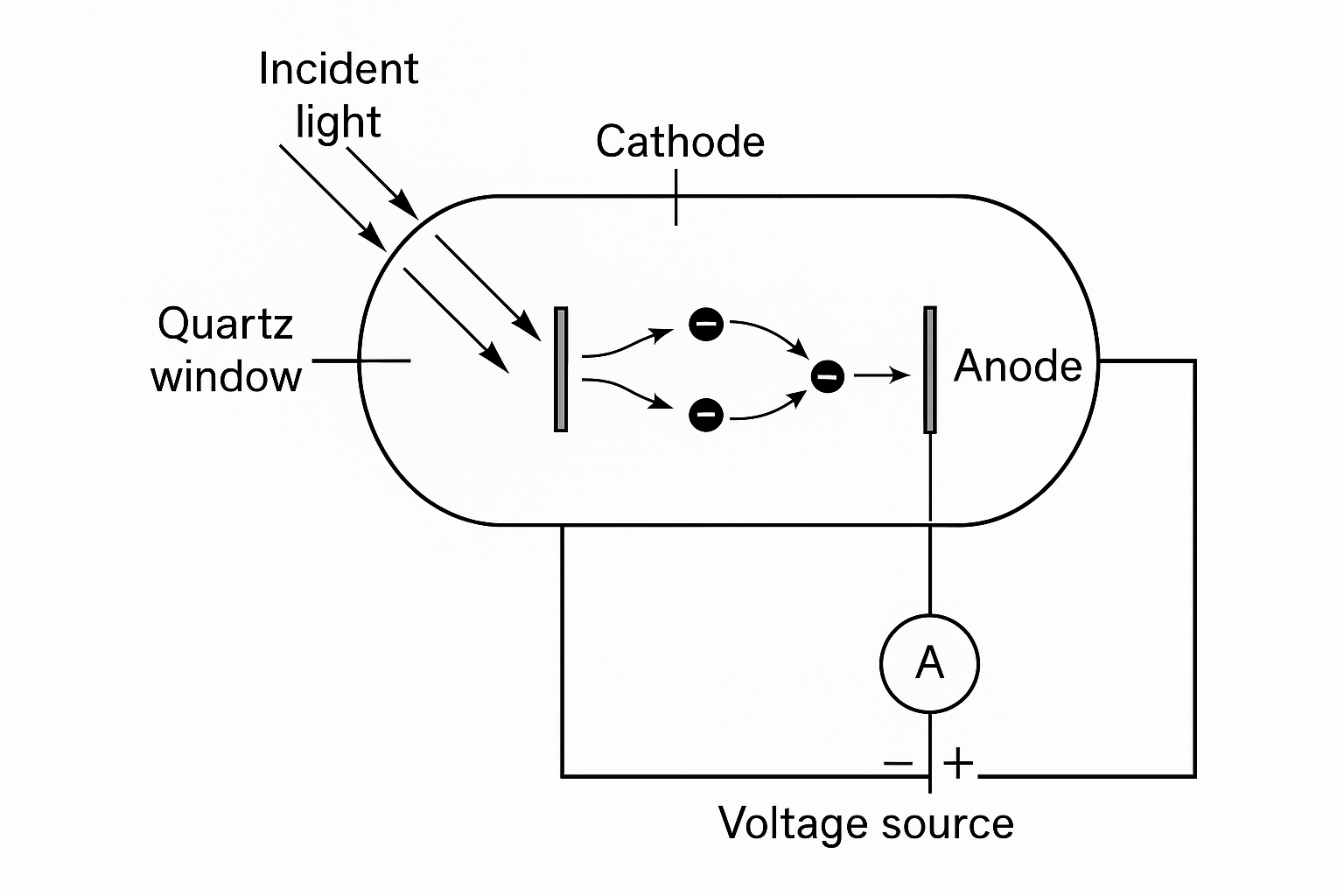
Philipp Lenard refined the early photoelectric experiments of Hertz by introducing a carefully controlled photoelectric tube. The apparatus consisted of two metal electrodes—a cathode and an anode—sealed within a glass envelope that provided a near-vacuum. The key components were:
- Cathode: a clean metal plate (often zinc or platinum) serving as the illuminated surface.
- Quartz window: allowed ultraviolet light to enter the tube without absorption.
- Anode: a collecting electrode positioned to receive emitted electrons.
- Adjustable voltage: an adjustable potential difference between the cathode and anode.
- Electrometer: a sensitive measuring device to record the resulting current (not shown).
When he illuminated the metal cathode, electrons were produced (the photoelectric effect) and ejected into the vacuum. They were collected by the anode. The rig could both apply a voltage between the anode and cathode as well as measure the current. In the experiments he measured how the current changed as light was presented and the potential difference was varied.
By sweeping the voltage, Lenard traced out a complete current-versus-voltage curve. Two features of the curve gave him two separate measurements:
- The saturation level (number of electrons). When the anode is positive, it collects every electron the light ejects, and the current levels off. The height of this plateau is the number of electrons emitted per second.
- The cutoff voltage (energy of the electrons). When the anode is made negative, it repels the electrons. Only electrons with enough kinetic energy can climb the barrier and reach the anode, so the current falls as the voltage becomes more negative. The current reaches zero at the stopping potential, where even the most energetic electrons are turned back. The position of this cutoff measures the maximum kinetic energy.
The plateau tells us how many electrons there are, and the cutoff tells us how energetic they are. Because they appear in different parts of the curve, Lenard could change the light and see which feature moved.
How the Electron Energy Was Deduced
The crucial measurement in Lenard’s experiment was the stopping potential, \(V_s\), the retarding voltage required to reduce the photoelectric current to zero. This provided a direct measure of the maximum kinetic energy of the emitted electrons:
\[ e V_s = \tfrac{1}{2} m v_{\text{max}}^2 \]
where \(e\) is the electron charge and \(v_{\text{max}}\) is the velocity of the fastest emitted electrons.
By systematically changing the light intensity and wavelength, Lenard discovered two key laws:
- Increasing intensity (at fixed wavelength) raised the saturation plateau, because more electrons were emitted, but the cutoff stayed at the same voltage. The stopping potential (\(V_s\)) did not change.
- Increasing frequency (decreasing wavelength) moved the cutoff to a more negative voltage, increasing the stopping potential—hence, the energy of the electrons.
These findings showed that the energy of photoelectrons depends on the frequency of the incident light, not its intensity—a result that could not be explained by classical wave theory.
Einstein’s photoelectric equation (1905) explains Lenard’s observations: \[ e V_s = h \nu - \phi, \]
where \(h\) is Planck’s constant, \(\nu\) is the light frequency, and \(\phi\) is the minimum energy required to emit the electron from a material into a vacuum. It is a surface-dependent material property (typically 2–5 eV for metals). In semiconductors used for photodiodes,this threshold is set by the bandgap, which for silicon is 1.12 eV.
At the same time, physicists were trying to explain the spectrum of light emitted by a blackbody—a perfect absorber and emitter of radiation. In 1900, Max Planck tackled this problem. He found a formula that matched the observed spectrum, but only if he assumed that energy exchange (joules) between matter and radiation occurred in discrete amounts.
\[ E = n h \nu \]
Here, \(n\) is an integer; \(\nu\) is the frequency (\(1/sec\)) of the radiation; and \(h\) is a constant — now called Planck’s constant (\(h = 6.62607015 \times 10^{-34}\) joule-seconds). Planck proposed that the oscillators in the material’s walls could only transfer energies in discrete steps. This quantization explained why the measured absorption and emission of light matched the observed spectrum, even though the light field itself was continuous.
In 1905, Albert Einstein went further. He proposed that we should not think of light as a continuous wave that becomes quantized through an interaction with the material. Rather, he argued, light itself quantized into discrete packets of energy—later called photons. The energy of each photon is proportional to its frequency, and inversely proportional to its wavelength
\[ E = \frac{h c}{\lambda} \tag{17.1}\]
where
- \(h\) = Planck’s constant (\(6.626 \times 10^{-34}\) J·s)
- \(c\) = speed of light in vacuum (\(3.00 \times 10^8\) m/s)
- \(\lambda\) = wavelength (in meters)
This hypothesis went beyond Max Planck’s work, which assumed the quantization was part of the mechanism when radiation interacted with matter. Einstein suggested that light in free space behaves as localized energy quanta, capable of transferring energy to electrons one photon at a time. His theory explained both Planck’s observations and all of Lenard’s experiments. His theory, however, left unexplained the many verifiable findings from Huygens, Fresnel, Maxwell and others concerning the wave nature of electromagnetic radiation. Even so, the photoelectric theory laid the groundwork for the next generation’s work in quantum physics that was needed to resolve these differences.
17.4 Wave-particle duality
For much of the 19th century, Newton’s idea that light was made of tiny particles (corpuscles) was set aside, as experiments overwhelmingly supported the wave theory of light—interference and diffraction patterns provided strong evidence for wave-like behavior. However, the photoelectric effect presented results that could not be explained by wave theory alone, forcing physicists to recognize that light sometimes behaves as a particle as well. This is the essence of the wave-particle duality.
Einstein did not ignore the wave phenomena. For much of his career, he worked towards a new set of principles that might be called a “statistical wave-particle” model, in which photons retain a wave-like “guiding field” or statistical distribution that determines their path. He imagined that individual photons are particles, but their collective behavior is governed by an emergent, wave-like probability distributions that creates the familiar diffraction patterns.
A different, revolutionary theory sprung forth from the next generation, including Neils Bohr. This theory, quantum mechanics describes electromagnetic radiation by a mathematical object called the wavefunction, which provides the probabilities of different outcomes. When experiments are designed to reveal wave-like effects (such as interference), light behaves as a wave. When experiments probe particle-like effects (such as the photoelectric effect), light behaves as a particle.
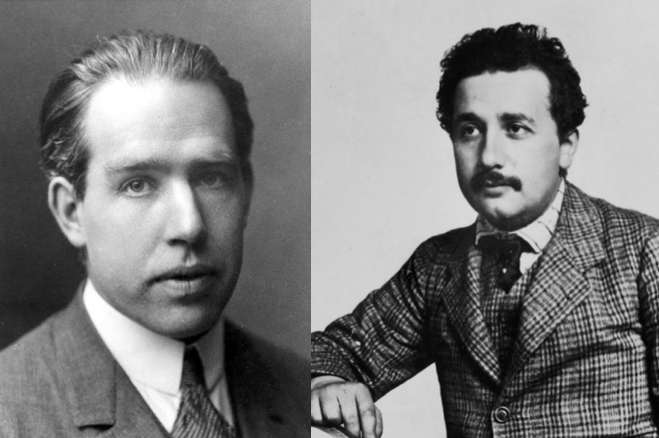
The young theorists argued that both descriptions are necessary, and neither alone is sufficient to fully describe the nature of light. Einstein was reluctant to accept this framing calling it implausible; Bohr argued that Einstein was clinging to classical intuitions about reality that quantum mechanics had shown to be inadequate. From Bohr’s perspective, the probabilistic nature of quantum mechanics wasn’t a sign of incomplete knowledge - it was a fundamental feature of nature at the microscopic scale. Bohr believed that concepts like “determinism” and “objective reality independent of observation” were classical prejudices that had to be abandoned. He argued that quantum mechanics was complete precisely because it recognized the fundamental role of measurement and the impossibility of simultaneously knowing all properties of a quantum system.
This duality remains a central and intriguing feature of quantum physics. If you don’t find all of this a bit puzzling, you may not be paying enough attention: Physicists disagree wildly on what quantum mechanics says about reality.
Einstein’s proposal of the photon was initially met with skepticism, as the wave theory of light was deeply established in physics. Even Einstein himself was uneasy with the resulting wave-particle duality and especially with the probabilistic foundations of quantum mechanics; he believed it pointed to an incomplete understanding of nature. He famously rejected this probabilistic view, remarking that “God does not play dice.” Niels Bohr responded, “Einstein, don’t tell God what to do.” The tension between wave and particle descriptions remains a central—and still unresolved—theme in physics.
In 1905—Einstein’s annus mirabilis—he published four groundbreaking papers that reshaped modern physics. In addition to the photoelectric effect, for which he was awarded the Nobel Prize, he introduced Special Relativity, showing that simultaneity is relative depending on the observer’s frame of reference. The excellent biography of Einstein by Walter Isaacson (2008) provides an accessible account of these discoveries and the broader scientific context.
Isaacson also details how Lenard, whose experimental work was important to Einstein’s theory became an outspoken anti-Semite. Lenard, who was awarded a Nobel Prize prior to Einstein, actively opposed Einstein’s recognition in the scientific community. As Isaacson also chronicles, Bohr and Einstein maintained a deep mutual respect and professional friendship throughout their careers.
17.5 Semiconductors and electrons
Atoms in a silicon semiconductor are arranged in a crystalline structure, and their electrons occupy specific energy levels grouped into two main bands: the valence band (lower energy) and the conduction band (higher energy). Under normal conditions, most electrons remain in the valence band. When a silicon atom absorbs a photon, an electron can be excited from the valence band to the conduction band (Figure 17.3).
17.5.1 Bandgap
The minimum energy required for this transition is called the bandgap, and it is measured in electron volts (eV). For silicon at room temperature (\(21^\circ\text{C}\)), the bandgap is 1.12 eV. Only photons with energy equal to or greater than this value can generate free electrons in silicon.

17.5.2 Wavelength effects in silicon sensors
There are several wavelength-dependent effects worth noting about silicon sensors. First, we can calculate the energy in Joules of a photon of wavelength \(\lambda\) using Planck’s photon energy formula (Equation 17.1).
We can convert from Joules (J) to electron volts (eV) using the relationship:
\[ 1~\text{eV} = {1.602 \times 10^{-19}}~\text{J} \tag{17.2}\]
A wavelength of 1100 nm has just enough energy (1.12 eV) to transition an electron across the bandgap: thus, silicon sensors are insensitive to electromagnetic radiation beyond 1100 nm, and infrared sensors must use different semiconductor materials (such as InGaAs). Second, photons with wavelengths shorter than 1100 nm have more than enough energy to excite electrons across the bandgap, so silicon absorbs radiation across the entire visible spectrum (approximately 400–700 nm).
Third, the probability that a photon excites an electron across the bandgap depends on the photon’s energy level. Higher-energy (shorter wavelength) photons are absorbed much closer to the surface of the silicon, whereas lower-energy (longer wavelength) photons penetrate deeper into the material before being absorbed. Short-wavelength (blue) photons generate electrons near the surface, while long-wavelength (red and near-infrared) photons generate electrons deeper in the silicon. This depth-dependence on wavelength has even been exploited to design color image sensors that separate colors by depth without requiring a surface color filter array (Section 23.5).
17.6 The random nature of photon absorptions
When we model light as a wavefunction, we can only predict the probability that a photon will generate an electron. This means that even with a perfectly stable light source, the number of electrons generated in a photodiode will fluctuate from one measurement to the next. These statistical fluctuations are a key feature of how light interacts with matter and are central to quantum optics.
The number of photon absorptions in a photodiode follows the Poisson probability distribution. This statistical property was formalized in the 1950s by two groups: one studying visual sensitivity in the retina (Pirenne (1951), Barlow (1956)), and another investigating the physics of electromagnetic radiation and image sensors (Mandel (1959)).1
The mean number of electrons generated is proportional to the light intensity: doubling the light intensity doubles the mean number of electrons (Preece and Haefner (2022)). This linear relationship holds over a wide range, until the sensor material saturates. However, because photon arrivals and electron generation are random processes, the actual number of electrons generated in each measurement fluctuates around this mean. These fluctuations are described by Poisson statistics.
Not every photon generates an electron. The ratio of generated electrons to incident photons is called the photodiode’s quantum efficiency (QE). QE can be measured as the slope of the line relating the number of incident photons (x-axis) to the number of generated electrons (y-axis). A QE of 1 (or 100%) means every photon generates one electron; a QE of 0.5 means, on average, half of the photons generate an electron.
\[ \mathrm{QE}(\lambda) = \frac{\text{number of electrons generated}}{\text{number of incident photons at wavelength } \lambda} \]
In practice, QE depends on wavelength due to the sensor material and device design. Manufacturers often provide QE curves showing efficiency as a function of wavelength, and we will examine examples later.
The photodiode is part of a circuit that stores and reads out the generated charge. While this circuitry can introduce nonlinearities and additional noise (Bohndiek et al. (2008)), the initial conversion from light to electrons is linear over a large range. Understanding this linear process is fundamental to CMOS image sensor operation; understanding the full system requires further study of the sensor’s electronic components, which we discuss in later sections.
17.7 Statistics of the photoelectric effect
The principles underlying the Poisson distribution of electrons are straightforward. Suppose we have a steady source of photons, all with the same wavelength. The probability of a photon arriving in any given small time interval, \(\delta t\), is constant. This is the defining property of a Poisson process: events occur independently, with a constant average rate.
If the probability that a photon generates an electron is also constant (equal to the quantum efficiency, QE), then each photon arrival is an independent chance to generate an electron. The resulting number of electrons generated in a given interval is also Poisson distributed, with a mean scaled by the quantum efficiency. This statistical fluctuation in the number of electrons is known as the shot noise of the sensor.
I referred to Poisson earlier - he was the French academician who tried to disprove Fresnel’s wave theory calculations. He predicted a bright point that appears at the center of a circular object’s shadow based on Fresnel’s theory—thinking it impossible. But experiments showed that the spot was present!
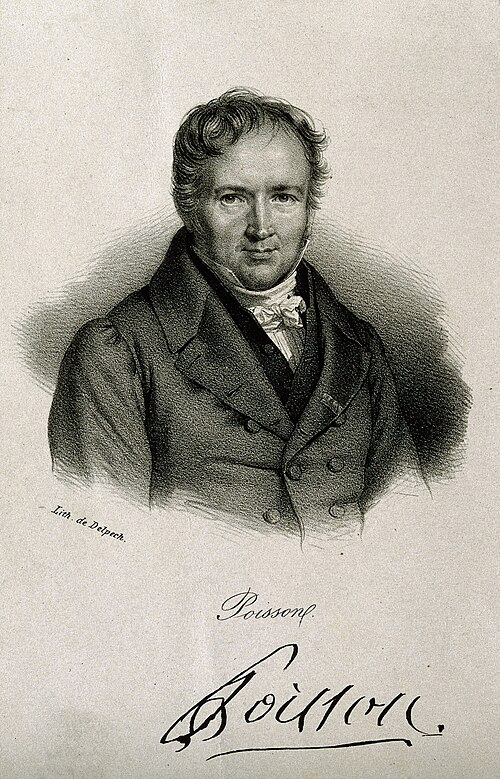
I refer to Poisson here for an entirely different reason: the famous probability distribution with his name. He developed the mathematics for the distribution in his 1837 work “Recherches sur la probabilité des jugements en matière criminelle et en matière civile (Researches on the Probability of Judgments in Criminal and Civil Matters)”. The goal of this work was to describe the number of discrete events occurring in a fixed interval of time or space, given a known constant mean rate and independence between events. His applications included jurisprudence and statistics such as the number of soldiers killed by horse kicks in the Prussian army.
Although it was developed for a completely different purpose, the mathematical framework he established applies directly to the arrival of photons from a constant light source. In imaging, each electron generation is considered an ‘event’, all events are identical, and the probability of an event in any small time interval is the same.
The Poisson formula describes the probability of observing \(n\) electron events, given a mean \(\mu\): \[ P(n; \mu) = \frac{\mu^n e^{-\mu}}{n!} \]
Here, \(\mu\) is both the expected (mean) number of events and the variance of the distribution (\(\sigma^2 = \mu\)). When quantifying noise in physical systems, we use the standard deviation (\(\sigma\)). The shot noise is therefore the standard deviation of this count:
\[ \sigma_{\text{shot}} = \sqrt{\mu} \tag{17.3}\]
This leads directly to a fundamental relationship in imaging: the signal-to-noise ratio (\(\text{SNR}\)) due to shot noise is the ratio of the mean signal to the shot noise:
\[ \text{SNR} = \frac{\mu}{\sigma_{\text{shot}}} = \frac{\mu}{\sqrt{\mu}} = \sqrt{\mu} \tag{17.4}\]
Because the SNR increases with the square root of the signal, higher signal levels (more captured photons) produce relatively cleaner, less noisy measurements.
The Poisson distribution fundamentally describes discrete, independent quantum events (individual photon arrivals), whereas the Gaussian distribution arises from the aggregate of many such events and is continuous. Even so, for large \(\mu\) (greater than about 15 or 20), the Poisson distribution closely resembles what one would find from a discretization of the Normal (Gaussian) distribution (Figure 17.5).
A primary difference between the two is that the Poisson distribution is defined only on non-negative integers, and for small values it exhibits a positive skew. As \(\mu\) grows, this skewness vanishes and the distribution becomes symmetric and bell-shaped.
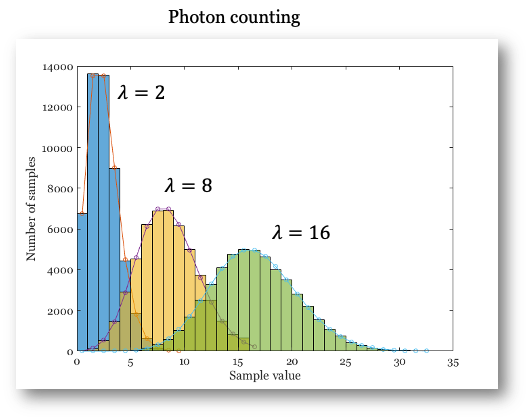
A key fact we will use repeatedly: for a Poisson distribution, the mean and variance are equal (\(\sigma^2 = \mu\)). This property distinguishes Poisson noise from other sensor noise sources (such as read noise), where the noise variance is independent of the signal level.
17.7.1 Physical factors that determine \(\mu\)
The mean number of electrons generated by a pixel, \(\mu\), is not a statistical abstraction—it is determined directly by the scene illumination, camera optics, and sensor geometry:
\[ \mu \approx \left(\frac{\pi}{4}\right) \left(\frac{1}{\mathrm{f}/\#}\right)^2 \Delta t \cdot A_{\text{pixel}} \cdot \int L(\lambda) \cdot \mathrm{QE}(\lambda) \, d\lambda \tag{17.5}\]
where \(\lambda\) is the optical wavelength. In practical terms, the mean signal \(\mu\) scales proportionally with four key factors:
- Scene Radiance (\(L\)): Brighter objects emit or reflect more photons per unit time and area.
- Aperture Area (\(\propto 1/(\mathrm{f}/\#)^2\)): A larger aperture (smaller \(\mathrm{f}/\#\)) collects more light from each scene point.
- Exposure Duration (\(\Delta t\)): Longer exposure times integrate photon arrivals over a longer duration.
- Pixel Area (\(A_{\text{pixel}}\)): Larger physical pixels collect more incident photons than smaller ones.
17.7.1.1 Small \(\mu\) vs. large \(\mu\) regimes
- Small \(\mu\) (\(\mu < 10\)): Typical in low-light environments (dim indoor scenes or night photography) and with small smartphone pixels (\(A_{\text{pixel}} < 1\,\mu\text{m}^2\)). Here, pixels capture only a handful of electrons. The Poisson distribution is visibly skewed, discrete photon arrival counts dominate the measurement, and shot noise is high relative to the signal (\(\text{SNR} = \sqrt{\mu} \le 3\)). In this regime, captured images appear grainy and noisy.
- Large \(\mu\) (\(\mu > 100\) to \(10{,}000+\)): Typical in daylight or with large pixels (\(A_{\text{pixel}} \ge 25\,\mu\text{m}^2\)) and longer exposures. Here, the pixel wells accumulate thousands of electrons. The Poisson distribution is practically indistinguishable from a continuous Gaussian distribution, and the SNR is high (\(\text{SNR} = \sqrt{\mu} > 100\)), yielding clean, smooth images.
You can see a step-by-step statistical explanation of photon arrivals followed by electron generation in the ISETCam script. The script demonstrates why, in conventional CMOS image sensors, both the incident photons and the resulting electrons follow Poisson statistics.
This relationship -Poisson distribution followed by another Poisson distribution- does not apply to other sensor types. When a photon absorption generates multiple electrons (photomultipliers and SPADs), the statistical distribution of the output requires some more thought (Section 23.10).
The history of these discoveries is fascinating but too detailed to cover here. For more, see these notes.↩︎